
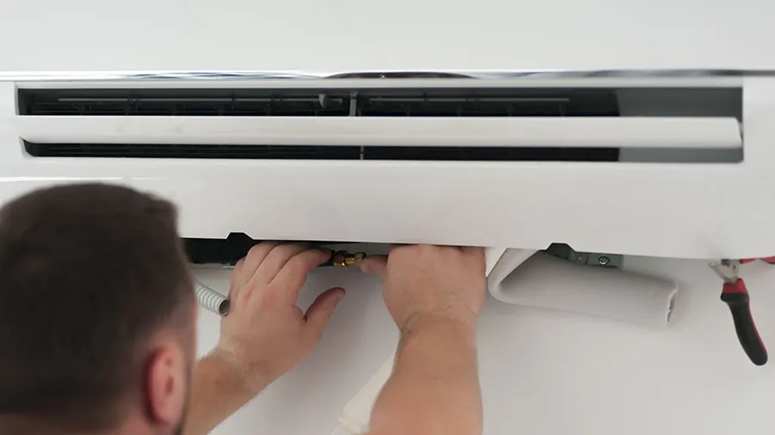
Competent installation of the air conditioner determines the cooling efficiency, noise level and service life of the equipment. During installation, it is important to correctly choose the location of the internal and external blocks, calculate the length of the route and the height difference, ensure reliable fastening, correct condensate drainage and safe connection to the electrical network, taking into account the load and protection.
The connection includes the laying of a freon line, vacuuming the system, checking for tightness and starting with control of operating parameters. To avoid leaks, vibrations and errors in electrical installation, you should order the installation of air conditioners at https://friros.fi from specialists who will perform the installation according to the technical requirements and put the equipment into operation.
Selection of a place for internal and external blocks, taking into account the route, drainage and vibrations
When choosing a place for internal and external units, it is important to assess in advance the route of the freon route, the possibility of organizing gravity drainage and potential sources of vibrations. Errors at this stage lead to difficult maintenance, increased noise, condensate leaks and deterioration of the air conditioner’s efficiency.
Internal block: route and drainage
The inner block is placed so that the route can reach the outer block along the shortest and straightest path: this reduces losses, simplifies vacuuming and reduces the probability of errors during soldering/rolling. It is important to avoid an arrangement in which the pipes will inevitably pass through hard-to-reach areas where it is difficult to control thermal insulation and tightness of connections.
- Do not direct the air flow to permanent workplaces and the sleeping area to avoid discomfort.
- Leave access to filters and fasteners for cleaning and revision.
- Reduces noise: does not place the block close to partitions that can resonate.
- They will check that the exit point of the route allows for a neat bend of the pipes without fractures and tension.
Outer block: drainage, vibration and fastening
The outer block is chosen so that the route does not turn out to be excessively long and does not require many turns; this improves refrigerant circulation and facilitates subsequent maintenance. It is important to ensure free inflow and outflow of air, do not place the unit in «pockets» and niches without ventilation, and also do not cover it with grilles and blind screens.
Vibrations and noise are critical: when installing on brackets, vibration dampers are used, the load-bearing capacity of the fasteners is correctly selected, and «weak» bases are excluded. Pipelines should not transmit vibrations to the wall and the internal unit — for this they avoid tight tension, ensure proper fixation and preserve the integrity of the thermal insulation. Condensate and water drainage during defrosting is also taken into account (if it is provided by the design): drops should not fall on passages, windows, facade elements and equipment below.
- Determine a place with sufficient carrying capacity and access for the service.
- Check that the route is laid without excess bends and with correct turning radii.
- Organize water drainage so as to exclude freezing, flooding and contamination of the facade.
- Apply vibration decoupling and exclude contact of pipes/brackets with elements capable of resonating.